
Teamwork makes the dream work.
By Paige Parish, EdD, LICSW
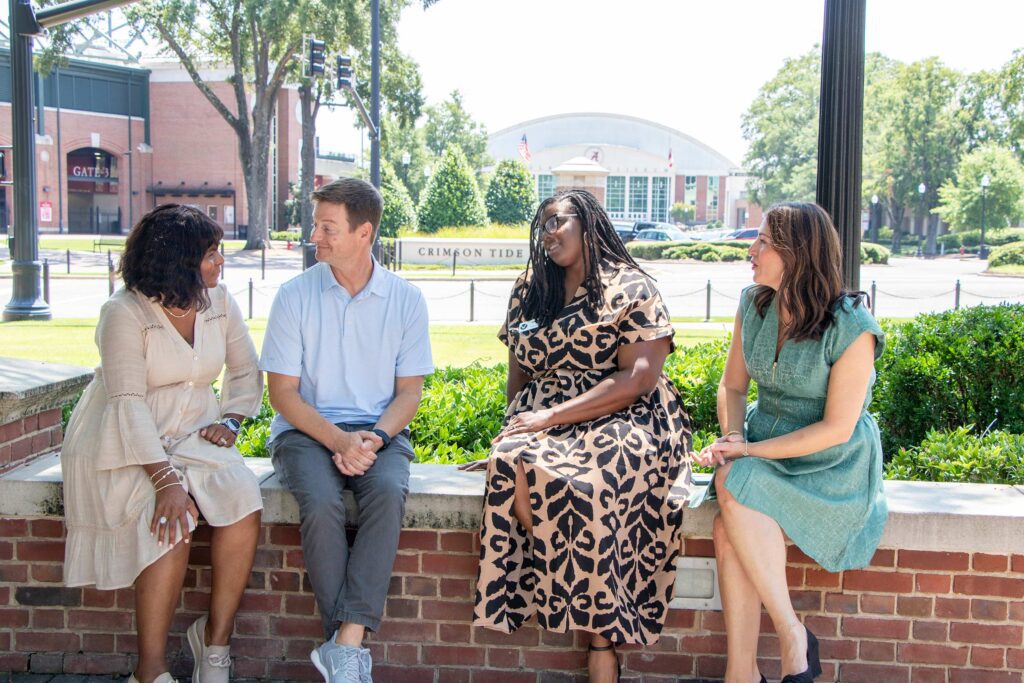
Together, everyone achieves more. Many hands make light work.
Everywhere you look, there are teams: teachers and parents teaming up to create the best educational opportunities for their students. Doctors, nurses, and receptionists working together for smooth workflows and warm welcomes. Partners, spouses, and generations working together to make families run. Teams support people across all arenas and stages of life.
Here at VitAL, we believe in the value of teamwork. This is demonstrated across our project teams as they collaborate daily with state partners, communities, care providers, organizations, and leaders. These levels of teamwork drive VitAL’s ability to improve the lives of Alabamians. Just as individuals benefit from strong relationships beyond themselves,¹ providers, educators, and researchers do their best work when supported by strong, collaborative teams.²˒³
Two Heads are Better than One… Right?
It is common knowledge that strong teams produce better outcomes for patients,² improve organizational processes,³ and increase employee satisfaction.1 However, strong teams are not something a leader simply stumbles into. Instead, they are the product of intentional processes. Two heads can be better than one, but only when they are in alignment, rather than pulling in opposite directions. Below are evidence-based ways to begin building strong teams of your own or enhancing the teams you’re already rocking.
Strong teams know the direction they are going.² There is a clear, easily stated, and frequently referenced vision, mission, and goal. Each member has a clear understanding of where the team is headed.
Each member knows and is equipped to carry out their role. Have you ever seen the movie Cool Runnings? It’s a classic about a Jamaican Bobsled team. On the bobsled team, there is one driver and one brakeman, and they know their role. What’s more, their coach ensures that they have the training to do their job with excellence. Both role clarity and support are essential to the creation of a strong team. ²
Traits of a strong team include clear communication, trust, and psychological safety. If you are going to lead a strong team, you must be clear in your communication. When leaders consistently follow through on their commitments and take time to truly listen to their team’s ideas, they create a culture where trust can grow and thrive. Clear communication, trust, and psychological safety are hallmarks of strong teams. Leaders build trust by following through, listening to ideas, admitting mistakes, and recognizing contributions. This kind of communication creates an environment where teams feel safe to collaborate, innovate, and grow. ⁵
Strong teams have positive environments. They limit complaining and stress gratitude. They encourage one another and share their stories. Strong teams care about the provider and the patient, but they also show care for their teammate’s humanity. At their core, strong teams create a culture where the members feel supported, valued, connected, and seen. ²˒³˒⁵
Strong teams are an essential ingredient for healthy communities. When teams have a clear sense of direction, well-understood roles, and communication rooted in trust and psychological safety, collaboration shifts from a potential source of strain to a powerful driver of progress. Here at VitAL, we believe teamwork is essential. We’re committed to supporting providers and community members like you with the tools and resources needed to build strong, effective teams, so we can, together, improve the lived experience of all Alabamians.
-
References
1 National Institutes of Health. (2025, March). Build social bonds to protect health. NIH News in Health. https://newsinhealth.nih.gov/2025/03/build-social-bonds-protect-health
2 Schmutz, J. B., Meier, L. L., & Manser, T. (2019). How effective is teamwork really? The relationship between teamwork and performance in healthcare teams: A systematic review and meta-analysis. BMJ Open, 9(9), e028280. https://doi.org/10.1136/bmjopen-2018-028280
3 McGuier, E. A., Kolko, D. J., Aarons, G. A., Schachter, A., Klem, M. L., Diabes, M. A., Weingart, L. R., Salas, E., & Wolk, C. B. (2024). Teamwork and implementation of innovations in healthcare and human service settings: A systematic review. Implementation Science, 19(1), 49. https://doi.org/10.1186/s13012-024-01381-9
4 Bragadóttir, H., Kalisch, B. J., Flygenring, B. G., & Tryggvadóttir, G. B. (2023). The relationship of nursing teamwork and job satisfaction in hospitals. Journal of Nursing Management, 31(3), 562–571. https://doi.org/10.1111/jonm.13749
5 Navío-Marco, J., Ardura, D., & Galán, A. (2025). Teamwork skills development in hybrid and online universities: The perspective of the future teachers. Journal of New Approaches in Educational Research, 14, Article 13. https://doi.org/10.1007/s44322-025-00032-1